Translate

Tuesday, June 12, 2018

Seven Times Rome Was Sacked

Rome has been seized and occupied by enemies so many times that it is hard to come up with an exact number. After each sacking, however terrible, Rome rose again, phoenix-like. Evidence of these assaults can still be seen today.
The Gallic Catastrophe
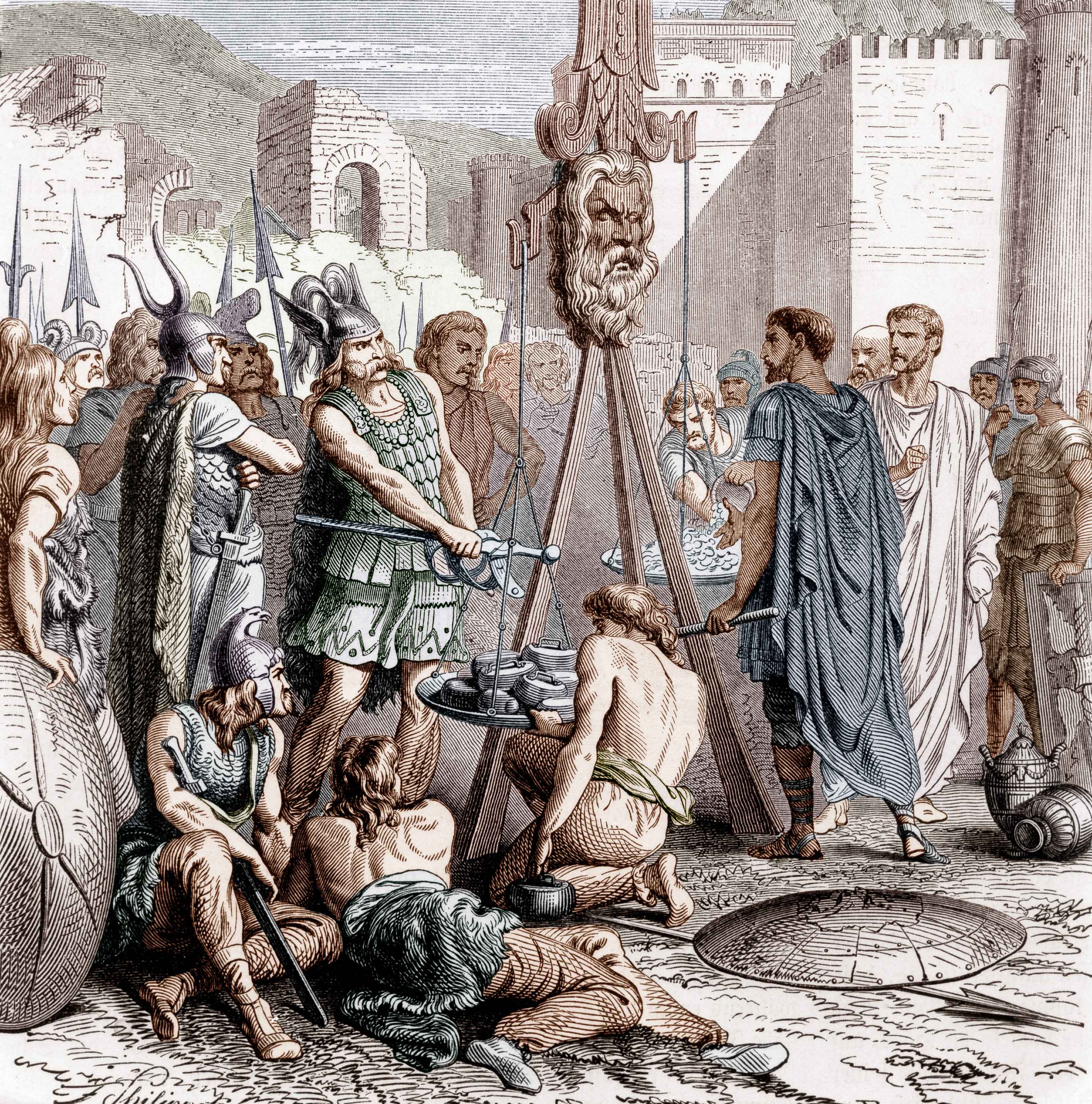
The Gallic Catastrophe, 387. (Credit: ullstein bild/ullstein bild via Getty Images)

387 BC

The Gauls’ attack on Rome more than 24 centuries ago is still the best remembered, thanks to the stories of the later Roman historian Livy. In them he recounts the Romans’ self-sacrifice and no-nonsense courage as, while the city below burns, they defend their last redoubt on the Capitoline Hill. The best known story is that of the geese, whose quacks in the night warn the Romans of a Gallic sneak attack. Yet visitors will look in vain for any signs of this struggle, and with good reason. Archaeologists have failed to find a burnt layer or any other evidence of damage from this time. Careful studies of the sources suggest an explanation. Livy’s stories were patriotic guff. Many historians now suspect that the Romans never held out on the Capitoline. They surrendered to the Gauls and did so promptly, bribing them with gold to go away. If it wasn’t a heroic choice it was a shrewd one. Their city preserved, and stung by the disaster, the Romans rose to become the superpower of the Mediterranean.
VIDEO: The Visigoths Sack Rome In 410 A.D Alaric and the Visigoths sack Rome after years of holding the city under siege.

410 AD

Rome had much more to lose eight centuries later, in 410 AD. By then it had grown from a small town to a vast metropolis and its population was 10 or 20 times greater. The attack of 410 was a devastating psychological blow to the Romans, who had thought their city invulnerable, but things could have been far worse. In a three-day sacking only a few buildings appear to have been burned, mostly in the Forum area. Then again Alaric, the barbarian Visigoths’ leader, had no wish to destroy Rome. He wanted to use it as a bargaining chip to help him get a homeland within the Roman Empire for his people. One building that was attacked was Basilica Amelia―an ancient mall with many bankers’ stalls. All that remains now is its floor. This is fenced off but still visible are a number of small green discs. These are coins that melted into the paving as the building burned. If Rome was fairly lucky in 410, that would change. In 455 the city suffered a much more destructive attack by the Vandals, raiding from their kingdom in Tunisia. A century later Rome suffered extensive damage when it was caught in the middle of 20-year struggle between the Ostrogoths and the Byzantine Empire, when it changed hands several times and was briefly empty of any inhabitants.

1084

Eleventh-century Rome was a medieval city like no other. Rich Romans lived in homes built into classical ruins― abandoned theaters, stadiums and long dry baths. The Colosseum was the city’s largest housing complex. In 1084 the Norman ruler of Southern Italy, Robert Guiscard, attacked Rome to rescue Pope Gregory VII, who the Romans had fallen out with, and who was hiding out in the fortress of Castel Sant’Angelo. Today visitors can still see the stretch of wall, just by Porta Latina, where the Normans are thought to have broken in, scaling the wall with ladders at dawn. Other telltale signs of the attack are found in a number of medieval churches that were repaired or rebuilt soon after this time. They replaced churches that had been strong points in the city, and were burned by the Normans to prevent them being used to block their retreat. Unlike most assaults on Rome, which involved prolonged sieges and poorly organized attacks, Guiscard’s assault was a highly professional operation, worthy of a special forces unit, and it may have been completed with the successful rescue of the pope in a matter of hours. Aside from a handful of churches Rome was little damaged. Once again the city had been lucky.
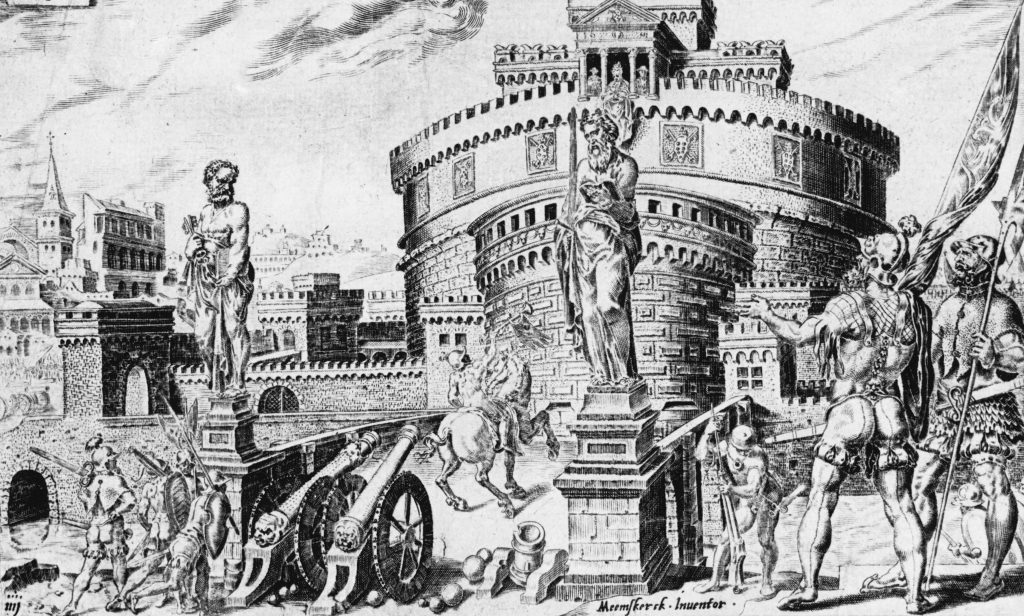
Siege of Rome by the forces of Emperor Charles V of Spain, 1527. (Credit: Hulton Archive/Getty Images)

1527

This was one of the most shocking and horrific assaults on Rome―and we know about it in great detail. For 10 months the city was occupied by the mutinous army of Emperor Charles V, killing, raping, kidnapping and torturing Romans. Thousands died. Matters were made worse because a large portion of the soldiers were Lutherans who felt a passionate hatred of Rome’s Churchmen. The altar of St. Peter’s was piled with corpses of those who had sought sanctuary there and for months the basilica was used as a stables by the Imperial cavalry. Scores of clerics were branded, tortured or castrated. Today visitors can see the Castel Sant’Angelo, where Pope Clement VII escaped to, safe from the horror below. Of the assault itself, signs are few. In the Vatican Palace one can still see, scratched into plaster of a fresco by Raphael, the name Luther, written by one of Charles V’s soldiers. And there is the Sistine ChapelMichelangelo’s ceiling paintings seem light and optimistic compared to disturbing, broody masterpiece, The Last Judgement. He painted the ceiling well before the sack but produced the Last Judgement after its terrors. One of the clearest signs of the 1527 sacking, though, is absence. Many European cities still have a few medieval timber houses but not Rome. Before the 1527 attack it had had thousands. Charles V’s soldiers ripped out timbers, doors and frames to burn as firewood, speeding Rome’s transformation to the city of fine stone homes.
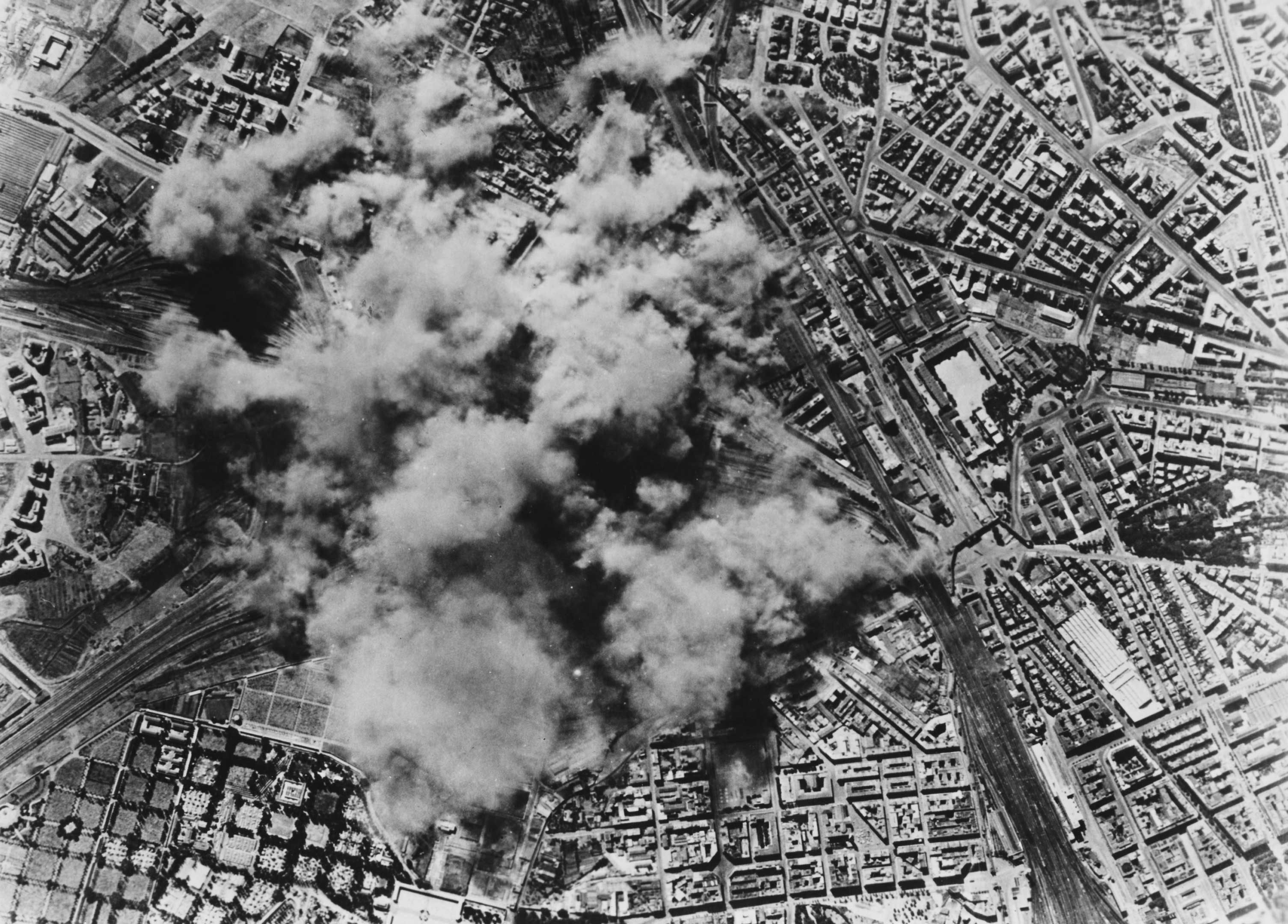
A view from one of the 150 Allied B17 Flying Fortress bombers attacking the San Lorenzo freight yard and steel factory in Rome on July 19, 1943. (Credit: Keystone/Hulton Archive/Getty Images)

1943-44

Here was another long and grueling occupation—eight months—this time by Nazi Germans and Italian Fascists. The assault left many traces though they require some searching out. In the cloisters of San Lorenzo church one can find part of a bomb, one of many that were dropped by Allied planes on July 19, 1943, damaging the San Lorenzo district and the church. Rome is not usually thought of as a city that suffered from air attack, largely because the center was little affected, but the outskirts were badly hit. Close to old railway yards one can find incongruously modern buildings in street of older ones, marking the spots where bombs struck. Some 7000 Romans died in the bombing. In Rome’s pavements, especially around the old Jewish Ghetto, there are also many small bronze tablets among the cobblestones, each bearing a name. These remember the homes from where Jewish Romans—some 2,000—were deported during the occupation. Few returned. On the via Rasella, close to the Trevi Fountain, small, jagged holes are evident in the walls of apartment blocks. These were left by a bomb that was detonated by Rome’s highly active resistance movement in March 1944, killing 33 German soldiers.Just south of Rome near the Appia Antica, one can visit a memorial at the Fosse Ardeatina caves, where 335 members of the resistance, Jewish Romans and others, who simply had the bad luck of being in the wrong place at the wrong time, were shot in reprisal for the bombing. Perhaps the most haunting relic of this time, though, is on Via Tasso, near the Lateran. Here the building used by the SS as a torture center has been carefully preserved as a Museum of the Liberation of Rome. As well as messages scratched into the walls by those held there, one can see windows that were bricked up, so neighbors could not see what was done or hear their cries. The museum, which is regularly visited by school groups, is kept both in memory of those who suffered and died there, and as a warning, so that nothing like it might ever happen again.
1943 Bombing in Rome
A view from one of the 150 Allied B17 Flying Fortress bombers attacking the San Lorenzo freight yard and steel factory in Rome on July 19, 1943. 

8 Things You May Not Know About the Praetorian Guard

They originated during the Roman Republic.Relief showing Praetorian Guard

Relief showing Praetorian Guard
The Praetorian Guard was a fixture of the imperial era, but their origins date back to groups of elite soldiers that protected generals during the Roman Republic. As early as the second century B.C., special units were selected to shadow famed Roman leaders such as Marc Antony, Scipio Africanus and Lucius Cornelius Sulla whenever they ventured into the field. Julius Caesar later enlisted his tenth legion as personal security, but the Praetorian Guard as we know it didn’t appear until shortly after Augustus became Rome’s first emperor in 27 B.C. After ascending to the throne, Augustus established his own imperial guards comprised of nine cohorts of 500 to 1,000 men each. The unit would endure as a symbol of imperial might for over 300 years. By A.D. 23, it even operated out of its own fortress, the Castra Praetoria, located on the outskirts of Rome.

They served as emergency firefighters.

great fire of rome
Fire was a constant threat in ancient Rome, and though the Empire had had a dedicated firefighting corps called the “Vigiles,” it wasn’t unusual for the emperor’s Praetorians to lend a hand in the event of a particularly unruly blaze. Guardsmen are known to have chipped in at a fire at the Temple of Vesta, and they were likely involved in setting up firebreaks during an infamous conflagration that leveled much of Rome during Nero’s reign. While the Praetorians significant numbers would have helped combat fires, their presence also had a public relations component. By dispatching his personal guard to assist in disaster relief, the emperor could show the citizenry that he was concerned for their welfare.

They performed at the Roman games.

roman games
The Praetorian Guard often handled crowd control at the Roman games, but they occasionally stepped into the arena and played an active role in the bloodshed. There is evidence that the Guard took part in gruesome wild beast hunts to demonstrate their combat prowess, and they played a notorious role in a “naumachia,” or staged sea battle, hosted by Emperor Claudius in A.D. 52. The spectacle saw as many as 19,000 men and some 100 boats clash in a mock naval engagement on the Fucine Lake. Most of the participants were prisoners and slaves, and the Praetorians, armed with catapults and ballistae, surrounded the battle on rafts to add to the mayhem and prevent any of the condemned from escaping.

They acted as a secret police force.

praetorian secret police
Credit: Hulton Archive/Getty Images
The Praetorians were known to engage in espionage, intimidation, arrests and killings to protect the interests of the Roman emperor. For clandestine operations, they may have employed a special wing of troops known as “speculatores.” Formerly a reconnaissance corps under the Roman Republic, by the imperial era this unit had graduated to serving as couriers and intelligence operatives in the service of the Caesar. Speculatores and other members of the Praetorians would disguise themselves as ordinary citizens at gladiator contests, theatrical performances and protests to monitor and arrest anyone who criticized the emperor. They also kept tabs on suspected enemies of the state, and in some cases they even secretly executed those judged to be an imminent threat to the emperor or his policies.

They played a role in assassinating several emperors.

Praetorian Guard proclaiming Claudius emperor
The Praetorians’ may have been tasked with protecting the Roman Emperor, but they were also the single greatest threat to his life. The unit was a major player in the webs of deceit that characterized imperial Rome, and they were willing to slaughter and install new emperors when tempted by promises of money or power. Disgruntled Praetorians famously engineered the assassination of Caligula and the selection of Claudius as his successor in A.D. 41. Among others, the Guard or their prefect also played a part in the murder of Commodus in 192, Caracalla in 217, Elagabalus in 222 and Pupienus and Balbinus in 238. In some cases, the Praetorians were partially responsible for both installing andmurdering a would-be emperor. Galba ascended the throne in A.D. 68 after winning the support of the Guard, only to be killed at their hands the following year after he neglected to properly reward them. Likewise, Emperor Pertinax was confirmed by the Praetorians in 193 and then slain just three months later when he tried to force them to accept new disciplinary measures.

They famously auctioned the emperorship to the highest bidder.

Didius Julianus
Didius Julianus (Credit: Anderson Alinari/Getty Images)
According to the ancient historian Cassius Dio, after murdering Emperor Pertinax in A.D. 193, the Praetorian Guard tried to cash in on the power vacuum by placing the Roman throne on the auction block. Following a brief bidding war between former consul Didius Julianus and Pertinax’s father-in-law, Titus Flavius Sulpicianus, the Praetorians reportedly sold control of the Empire to Julianus for the enormous sum of 25,000 Roman sesterces per man. The incident is one of the most notorious episodes in the unit’s history, but some historians argue that Dio’s account of an imperial “auction house” is overblown. While Julianus paid the Praetorians a fortune for their support, the Guard was equally motivated by fear that Sulpicianus would seek revenge for the killing of his son-in-law after ascending the throne.

They once fought against one another in battle.Vespasian crowned emperor (Credit: DeAgostini/Getty Images)


Vespasian crowned emperor (Credit: DeAgostini/Getty Images)
One of the most unusual incidents in the Praetorians’ history came in A.D. 69, when the general Vitellius defeated the Emperor Otho and seized the Roman throne. Fearing assassination at the hands of Otho’s loyal Praetorians, Vitellius dismissed the standing members of the Guard and replaced them with a new, larger force of troops recruited from his own legions. Unfortunately for Vitellius, his reign lasted mere days before Vespasian, the commander of the legions in Judea, declared himself emperor and moved on Rome. Vespasian enlisted several of the Otho’s now-unemployed Praetorians in his army, and these aggrieved soldiers later clashed with Vitellius’ Guard in a series of heated battles on the outskirts of the city. Vespasian ultimately prevailed, and the exiled Praetorians were restored to their former positions.

They were disbanded for supporting a pretender to the Roman throne.


Battle of the Milvian BridgeBattle of theMilvian Bridge
The structure of the Praetorian Guard was permanently altered in the late-second century, when the Emperor Septimius Severus dismissed its members and began recruiting bodyguards directly from the legions. Still, their run as the guardians of the Roman throne didn’t officially end until the fourth century. In 306, the Praetorians tried to play the role of kingmaker one last time when they installed the usurper Maxentius as the western emperor in Rome. Following a dizzying chain of civil wars and rival claims to the throne, Maxentius and his Praetorians were confronted by the Emperor Constantine at 312’s Battle of Milvian Bridge. While the Praetorians supposedly made a valiant last stand along the Tiber River, they were soundly defeated, and Maxentius was killed. Convinced the Praetorians could no longer be trusted, Constantine disbanded the unit once and for all, reassigned its members to the outskirts of the Empire, and oversaw the destruction of their barracks at the Castra Praetoria.

Thursday, June 7, 2018

WHEN CLASSICAL MEET WITH HIP HOP


WHAT ARITOTLE'S & PLATO Said ABOUT CHILDREN


The rattle is a toy suited to the infant mind, and education is a rattle or toy for children of larger growth.

PLATO SAID :


Lessons from History: The Parthian Defeat of Rome

hey poured gold down his throat, cut off his head, and sent it back as a warning to others.
No, this is not a scene from the latest episode of Game of Thrones; this was the passing of Marcus Licinuis Crassus in 53 BC.[1] Rome’s richest man, a member of the First Triumvirate with Julius Caesar, and the man responsible for putting down the pirates that menaced the Mediterranean, met his ignoble end fighting the greatest challenge the Romans ever faced in the east: Parthia.

Map of the Achaemenid Persian Empire at its height with the region of Parthia marked in a red circle (Wikimedia Commons)
Persia was the preeminent military, political, and cultural power in the ancient world from 550 B.C. to 330 B.C. With its heartland in modern day Iran, its empire spanned from Afghanistan to Turkey at its apex. It all came crashing down in spectacular fashion when Alexander of Macedon rose to power and led a ruthlessly efficient military machine on a path of conquest that brought him all the way to the Indus River. He tried his hardest to unify the Persian state with his own but, when he died at the age of 33 in 323 B.C., his empire immediately collapsed into a host of warring factions. Three of his Greek generals went on to found the three largest states in the Eastern Mediterranean by the time Rome rose: the Seleucids in Turkey and Syria, the Antripatrids (later the Antigonids) in Greece, and the Ptolemians in Egypt. In the Persian heartland, however, ethnic Persians waging a proto-nationalist campaign kicked out the remnants of the Greek invaders. Known as Parthians due to the origins from the titular province in north-eastern Iran, they established a small state that expanded outward as the Alexandrian generals quarreled with one another.
For centuries after his death, every Greek warlord in the Western World claimed their legitimacy through Alexander and the desire to rebirth his Empire. Rome, too, took up this mantle as it expanded eastward into the Greek mainland. Beginning first in Greece and Macedonia, they waged a brutal war with the beleaguered Seleucids and conquered all the territory they possessed in the modern Middle East. This brought Rome’s borders right onto those of Parthia. Both were rising states with expansionist ambitions and a border that sat on porous, easily invadable territory. The stage was set for an epic confrontation between the two great powers.
Map of the Roman-Parthian border with the location of Carrhae shown in a red circle (University of Guelph)
Unfortunately for Rome, this manifested in the ill-fated expedition of the afore-mentioned Crassus in 54 BC. The expedition met its unfortunate end on the plains of Carrhae in south-eastern Turkey along the Syrian border.
How did the Parthians manage to resist Rome for so long? Their success rested on three key disparities between them and their Roman opponents:
1)     Assymmetric Military Advantage

A Roman Legionnaire (left) facing his greatest threat since Hannibal: Parthian horse archers using the Parthian Shot (Wikimedia Commons)
The Roman legion was the paragon of military efficiency in its day. The strict discipline, advanced military technology, and sheer numbers were widely feared even before they began leaving the Italian peninsula. It was by no means a perfect force, as its travails against Hannibal in preceding centuries demonstrated, but the system itself was markedly better than any other fielded even with bad generalship. How then was it so ineffective against Parthia?
Unlike the other opponents the Romans fought in the preceding six centuries, the great bulk of the Parthian army were horse archers rather infantry or melee cavalry. Noted for the infamous “Parthian Shot,” their horsemen would rush forward to engage Roman infantry, retreat, then abruptly turn in their saddles to fire a shot directly behind them. The slow, methodical legionnaires were then rendered ineffective since they could not physically reach their assailants. The horse archer can be equated with modern fears about Medium-Range Ballistic Missiles (MRBMs); they were mobile, highly survivable, and could take out slower assets with near impunity.
These techniques were perfect for the open terrain on the Roman-Parthian border. If the topography had been less open, such as the forests of Gaul or Germania, Parthian tactics would have been less effective. The Parthians, though, did not need an army that could fight on different terrain because that is not where they needed to fight nor chose to fight. This brings us to the second advantage Parthia held over the Romans.
2)   Strategic Focus
The Parthians never harbored ambitions to conquer Rome; their strategy consisted of resisting Roman incursions and making their own when Rome was politically weak (see discussion below). Since the Parthians did not commit their resources into futile all-or-nothing fights with Rome or engage them on disadvantageous terrain, they always maintained a strong conventional deterrent that altered Rome’s calculus away from intervention.
Map showing the Parthian Empire in relation to the territory of the Scythian nomads. Without a central government, the Scythian tribes could only pose occasional threats in Parthia’s east (Wikimedia Commons)
The Parthians also had the strategic benefit of having fewer serious external competition; its western border was solely with Rome and the neutral kingdom of Armenia (the site of many proxy wars between Rome and Parthia). To their east were far weaker and divided opponents, namely the Scythians and Bactrians. Rome, on the other hand, was beset by strong enemies on all sides. These included: restive tribes in Gaul and the Danube region, lingering discontent in Numidians North Africa, a still-unitary Egypt, and a vascillating client state in northern Turkey. These challenges both demanded military resources and political attention to effectively control. Even if Rome had more money and soldiers than the Parthians, only so many of them could be dedicated toward fighting the Parthians.
3)   Stronger Political Core

(From the Left) Marcus Licinuis Crassus, Julius Caesar, and Marc Antony. All of the men tried to invade Parthia. The first one actually crossed the border and was killed. The other two were killed by Romans before even getting there (Wikimedia Commons and the Musee Des Augustins)
Parthian politics were cold and brutal. Succession crises were common and factions killed one another as they vied for the Parthian crown. There were even instances of Parthian claimants to the throne finding refuge in Rome, like exiled dictators, waiting for the opportune moment to return.
Roman politics during the late Republic and early Empire made Parthia look like Switzerland. The invasion of Parthia planned by Julius Caesar in 44 BC to avenge the death of Crassus (and punish the Parthians for their support of his rival, Pompey) was cancelled when Caesar fell to assassins’ blades on the Ides of March. The resulting civil war claimed thousands of Roman lives both on the battlefield and during the infamous proscriptions during which whatever faction happened to hold power would murder people and then “nationalize” their assets. After years of civil war, Rome finally found its footing under the Second Triumvirate. Marc Antony amassed his own army to take on the Parthians and managed to expel them from Syria in 33 BC only to have to turn around to fight his political partner Octavian in yet another civil war.
Octavian eventually succeeded in unifying the Roman state under his autocratic rule but, by then, he was in no position to challenge any external power. Crippling debts were poised to ruin the state. Opposing factions, though cowed by Augustus’ power, still opposed him behind the scenes. Octavian was forced to reduce to total number of legions to consolidate his hold on the Empire and reduce the risk of another civil war. Rather than risking another Parthian encounter in his weakened state, Octavian instead signed a landmark peace agreement that designated permanent borders in exchange for the legionary standards lost during Crassus’ expedition 33 years earlier. The Roman-Parthian drama would continue in fits and starts over the remainder of their very existences but, after that fateful treaty signed by Augustus, Rome finally admitted that it would fully never replicate Alexander’s conquest of Persia.
The cruel lesson for the United States to take from the Roman experience with Parthia is that an adversary with technology designed specifically to defeats its army, combined with stronger political will, is bound to come out on top of any conflict. Defeat does not just come on the battlefield. Just like Rome, the United States has a great number of serious threats: a bellicose Russia, an increasingly-assertive China, a still-problematic Iran, and trans-national terrorism. Unlike many of these antagonists (and the Parthians before them), the United States does not have the luxury of dedicating its resources to countering just one of these threats. The United States’ political system, after years of war and deep partisanship that conjures images of Caesar’s Rome, is brittle and unable to tackle any of these challenges. The lesson from Parthia is that to defeat the United States is merely to outlast it and negotiate for what you truly want.
Fortunately, for the United States, the peace under Augustus is not the end of the story. Over the following two centuries, the tables would turn and the Parthians’ political structure collapsed. Years of dynastic feuds and rival claimants to the throne made Parthia vulnerable to strong Roman Emperors such as Trajan (115 A.D.) and Septimus Severus (198 A.D.). The Parthian state was overthrown by internal revolution and a new Persian dynasty took its place. The final lesson for the United States is this: it is never too late to recalibrate and nothing is over until it is over.
Matthew Merighi is a civilian employee with the United States Air Force’s Office of International Affairs (SAF/IA) currently transitioning to pursue a Masters’ Degree at the Fletcher School. His views do not reflect those of the United States Government, Department of Defense, or Air Force but hopes his country can stand up to the Parthians.
Note
[1] There is no concrete proof that the gold-pouring incident is true apart from the reports of the Roman historian Cassius Dio but it definitely gets the point across.